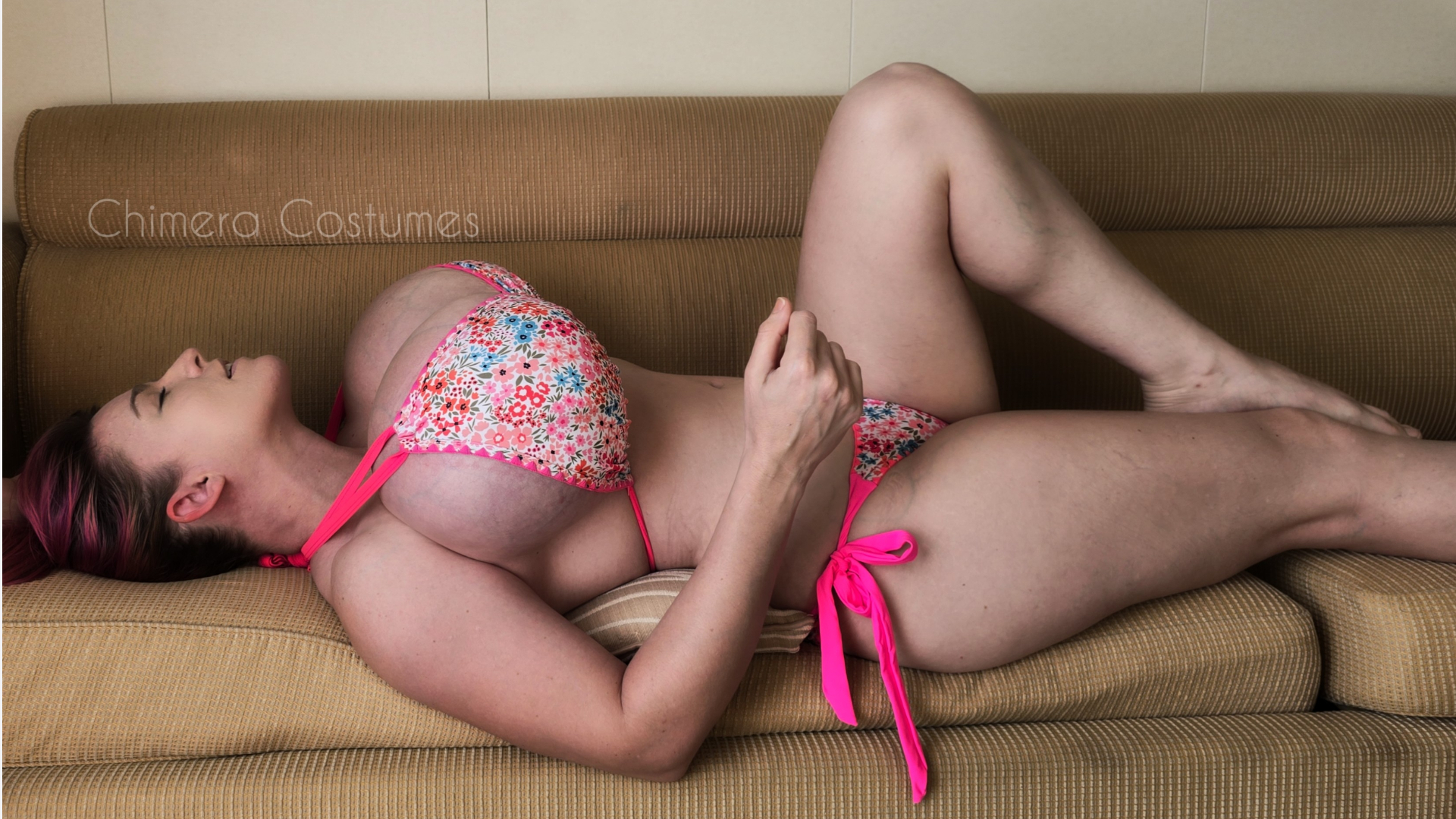
The Weight Nobody Talks About
When most people — especially men — search online about large breasts, they're looking for something very different from what this page offers. But if you've landed here, you're about to learn what it actually means to carry a massive chest through everyday life. The reality is not glamorous. It is often painful, exhausting, and genuinely limiting in ways that go largely undiscussed.
An average D-cup breast weighs approximately 0.9–1.1 kg (about 2 lbs). An F-cup breast weighs around 1.3–1.5 kg per side. At an H cup or beyond, each breast can weigh 2–3 kg or more. This is weight carried forward of the body's center of gravity, every hour of every day. The cumulative physical effect on the spine, muscles, skin, nerves, and daily activities is enormous.
This page covers the major areas of daily life that large breasts genuinely impact — not to shame anyone's body, but to educate. If you are a woman who lives this reality, you deserve to see it acknowledged clearly. If you are someone who has never thought about it before, welcome to the conversation.
Sleep: The Nightly Struggle
Sleeping comfortably with large breasts is a genuine challenge that affects sleep quality and can contribute to chronic fatigue. The core problem is positional: every sleeping position creates a different problem.
Sleeping on your back shifts breast weight onto the chest wall. For very large busts, this can restrict full chest expansion, making deep breathing feel labored. Some women report feeling like they can't fully inhale when lying flat.
Sleeping on your side — the most common sleep position — means the upper breast pulls away from the chest under gravity, putting strain on the Cooper's ligaments (the internal connective tissue that gives breasts their shape). The lower breast is compressed against the mattress or into the chest. Over the course of a night, this contributes to shoulder and neck pain, breast soreness, and — over years — accelerated sagging due to constant ligament stress.
Sleeping on your stomach is often uncomfortable or impossible with a large bust, as the breasts create an uneven surface that strains the neck and lower back.
Additionally, intertrigo — a skin rash caused by moisture and friction in the skin fold beneath large breasts — is worsened by lying down, where the fold is compressed and airflow is reduced. This is a medical condition requiring treatment, not just a cosmetic concern.
Many large-busted women develop elaborate pillow arrangements, use soft sleep bras for support, or sleep in specific positions to minimize discomfort. It is not unusual for this to take years to figure out. Read our full sleep guide →
Studies on women seeking breast reduction surgery consistently find that disrupted sleep is among the most commonly cited quality-of-life impacts, alongside back pain and exercise limitation.
Driving a Car
Driving with a large bust creates practical difficulties that are rarely discussed but very real.
Seatbelt placement is the most common issue. The standard three-point seatbelt is designed to cross the chest diagonally from shoulder to hip. On a woman with a large bust, this belt often rests across the breast tissue rather than the sternum, creating uncomfortable pressure — particularly on longer drives. Women frequently adjust the belt to sit behind them or under the arm, which significantly reduces its protective function in a collision.
Aftermarket seatbelt adjusters and chest clips exist to reposition the belt over the shoulder and away from breast tissue, allowing it to sit correctly. These are inexpensive and widely available, but rarely mentioned in any mainstream driving guidance.
Reaching across the body — for a passenger, for controls, or to check mirrors — requires trunk rotation that can be restricted by a large bust, particularly in tighter vehicle cabins. Parallel parking, which requires turning the upper body significantly, can also be physically awkward.
Fitting comfortably in the driver's seat of some vehicles is also an issue. Sports car bucket seats with bolsters designed for a narrower chest profile can be uncomfortable. The steering wheel distance that works ergonomically may be limited when a large bust reduces clearance.
Clothing Shopping: The Invisible Tax
Clothing shopping for large-busted women is one of the most consistently frustrating daily-life experiences documented in this community. It is not about vanity. It is about the functional reality that the mainstream fashion industry largely ignores bodies above a B-cup.
The fit problem: Most tops, dresses, and jackets are graded assuming a B-cup proportional to the shoulder and waist measurement. If you wear a size that fits your shoulders, the chest is too tight — or the fabric pulls open, gaps at buttons, and strains at seams. If you size up to fit the chest, everything else is too big.
Button-up shirts are effectively impossible to buy off the rack for most women above a D cup. The gap between buttons is a near-universal experience. Read our button-up guide →
Bra shopping is its own ordeal. Most chain lingerie stores stock a limited size range — typically 32–38 A–DD — that covers only a fraction of the actual size distribution of the population. The majority of women with larger busts wear a size that is simply not available in most stores, forcing them to specialist retailers or online shopping with all its return complications. Full bra fitting guide →
Swimwear is among the worst categories. Finding a swimsuit where the top fits the bust without the bottoms being three sizes too large, or where the cups actually provide support rather than just decoration, requires dedicated searching in specialist brands at a significant price premium.
The financial cost of being large-busted is real: specialist bras cost significantly more than standard sizing, often $60–120 per bra versus $20–40 at standard sizes. This is sometimes called the "busty tax."
The average well-fitted bra in an extended size (FF cup and above) costs two to four times as much as a standard-size bra — and lasts less time because the structure works harder.
Exercise and Physical Activity
Exercise is one of the areas where a large bust creates the most significant practical barriers. The problem is primarily one of movement and support.
During high-impact activities — running, jumping, aerobics, cycling — breast tissue moves in a figure-eight pattern with considerable force. Without adequate support, this movement is not just uncomfortable; it can be painful, and repeated unsupported movement contributes to long-term stretching of Cooper's ligaments and accelerated sagging.
Standard sports bras use a compression model — squeezing breast tissue flat against the chest. Above a D cup, this becomes inadequate. The alternative — encapsulation sports bras that surround each breast individually in a structured cup — are more effective but also more expensive and harder to find in extended sizes. Sports bra guide →
The practical result is that many large-busted women avoid exercise not from laziness but because it is genuinely uncomfortable without proper equipment. Research on women seeking breast reduction consistently finds exercise avoidance as one of the major quality-of-life impacts. Activities like running, jumping rope, and high-impact aerobics are often simply abandoned.
Even lower-impact activities are affected. Yoga poses that require lying face down are uncomfortable. Weight training requires careful attention to form because the forward breast weight affects posture and muscle recruitment. Swimming is often the most comfortable option because the water supports breast weight — but finding a swimsuit that fits for swimming laps is its own challenge.
Back, Neck and Shoulder Pain
Chronic musculoskeletal pain is the most widely documented medical consequence of large breasts. The mechanism is straightforward: sustained forward load on the upper body causes the posterior chain (back, shoulder, and neck muscles) to work continuously to counterbalance the weight. Over time, this leads to muscle fatigue, inflammation, and postural changes that compound the problem.
Specific documented issues include:
- Upper back and thoracic pain — the most common complaint
- Neck pain and tension headaches — referred from the trapezius and cervical spine
- Shoulder groove indentations — permanent or semi-permanent grooves in the shoulder tissue from bra strap pressure
- Brachial plexus compression — nerve compression from bra straps causing tingling or numbness in the arms and hands
- Postural kyphosis — forward rounding of the upper spine that can become structural over time
Full back pain guide → | Posture guide →
Skin Complications
Skin problems caused by a large bust are often overlooked in mainstream health discussions but are a significant quality-of-life issue.
Intertrigo is a rash in the skin fold beneath the breast caused by moisture, heat, and friction. It ranges from mild redness and irritation to open, cracked, infected skin. It is more common in warmer climates and seasons, and in women with larger busts where the fold is deeper and more enclosed. Treatment requires keeping the area dry, using barrier creams, and in infected cases, antifungal or antibacterial treatment.
Heat rash under the breast is also common and worsened by bra underwire pressing into the fold. Chafing from bra bands, underwires, and fabric against sensitive breast skin is an almost universal experience for large-busted women in warm weather or during physical activity.
Psychological and Social Impact
The physical challenges of a large bust have documented psychological consequences. Unwanted attention from a young age, difficulty participating in sports and physical activities, challenges finding appropriate clothing, and chronic pain all contribute to a complex relationship with one's own body.
Research consistently shows that women with macromastia (very large breasts) report significantly lower scores on quality-of-life measures related to physical functioning, pain, social functioning, and emotional wellbeing compared to the general population — and that these scores improve significantly after breast reduction surgery.
This is not about body shame. It is about acknowledging that living with a massive chest is genuinely hard work, and that the women who do it deserve honest recognition of that reality. Mental health and body image →
When Surgery Becomes an Option
Breast reduction surgery (reduction mammoplasty) is a significant medical procedure that is performed to relieve the physical symptoms associated with macromastia. It is not purely cosmetic. In many countries, including the United States, it may be covered by health insurance when medical necessity is documented — typically through evidence of chronic pain, skin conditions, postural problems, or nerve symptoms that have not responded to conservative management.
The decision to have breast reduction surgery is deeply personal. This site does not advocate for or against it. What we do advocate for is that women have accurate information about all their options — including the medical route. Breast surgery information →

Chimera Costumes — Heidi Lange
Heidi documents the real, unfiltered experience of living with a large chest — including the physical challenges most people never talk about. She is the creator behind ChimeraCostumes.com and one of the most honest voices in the space about what it actually feels like to exist in this body.